

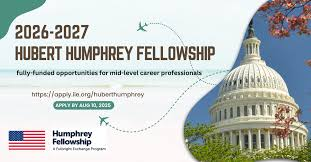
For mid-career professionals looking to take their leadership to the next level, the Hubert H. Humphrey Fellowship Program offers a unique opportunity that stands apart from traditional academic scholarships. Named after the late senator and vice president who dedicated his life to public service and international cooperation, this fellowship brings accomplished professionals from designated countries to the United States for a year of non-degree study, professional development, and cultural exchange -7.
Unlike the Fulbright Foreign Student Program which supports degree-seeking graduate students, the Humphrey Fellowship is designed specifically for experienced professionals who already have established careers and want to enhance their leadership capacity without pursuing another degree. If you are someone with at least five years of professional experience, a track record of public service, and a clear vision for how an American experience could amplify your impact at home, this program deserves your attention.
What exactly is the Humphrey Fellowship? It is a ten to twelve month program that combines graduate-level academic coursework with professional development activities tailored to each Fellow’s interests and goals . Fellows are placed at participating U.S. universities in theme-based groups of approximately ten people, creating a cohort experience that fosters collaboration and lasting professional networks -5. Host campuses have included prestigious institutions like American University, Arizona State University, Cornell University, Johns Hopkins University, Michigan State University, Vanderbilt University, and many others -5-7.
The program focuses on specific fields organized into several broad categories . Under Human and Institutional Capacity, eligible fields include economic policy and finance, public policy analysis and public administration, technology policy and management, and human resource management. The Rights and Freedoms category covers communications and journalism, law and human rights, international religious freedom, and trafficking in persons policy and prevention. Sustainable Lands includes agricultural and rural development, natural resources and environmental policy, and urban and regional planning. Thriving Communities encompasses public health policy and management, substance abuse education and policy, educational administration, and higher education administration.
Eligibility requirements are consistent across countries with some variations. You must be a citizen of a participating country and currently reside there at the time of application . You need at least a four-year bachelor’s degree and a minimum of five years of full-time professional experience beyond that degree . The program seeks demonstrated leadership qualities, a record of public service or community involvement, and excellent English communication skills . Importantly, preference is given to applicants who have not had extensive or recent experience in the United States, as the program values fresh perspectives and mutual exchange.
Certain individuals are not eligible to apply. Dual citizens of the United States and another country, U.S. permanent residents, and individuals who have attended graduate school in the U.S. for more than one year during the past seven years are ineligible. Faculty members or academic researchers without management responsibilities generally do not qualify, with exceptions for specific fields like substance abuse prevention -5.
The application process requires several components. You will need to submit an online application through the IIE portal at apply.iie.org/huberthhumphrey . This includes academic transcripts from all post-secondary institutions, certified copies of diplomas, and two or three letters of recommendation, with at least one from a current supervisor or employer. Two well-reasoned essays are critical: a proposed professional development plan describing your area of interest and how it connects to your country’s development goals, and a personal statement describing your professional goals and public service commitment -1. English proficiency test scores may be required at the time of application or provided to nominated candidates later, depending on your country .
Application timelines vary by country but generally require starting at least twelve months before your intended program start. Many countries had deadlines between June and August 2025 for the 2026-2027 cycle. You should check with the U.S. Embassy or Fulbright Commission in your country for specific dates and requirements.
The selection process is rigorous and multi-stage. Country-level Fulbright Commissions or U.S. Embassies conduct initial screening and interviews for top candidates . Recommended candidates then undergo technical review by the Institute of International Education and final selection by professional review committees and the J. William Fulbright Foreign Scholarship Board in the United States . Successful candidates are notified several months before the program begins.
What does the fellowship cover? The benefits are comprehensive and truly fully funded . The package includes international round-trip air travel to and from the United States, tuition and fees at the assigned host university, a monthly maintenance stipend for living expenses, a one-time settling-in allowance, accident and sickness insurance coverage, a book allowance, a one-time computer subsidy, and a professional development allowance for activities like conferences, field trips, and professional visits. Pre-academic English language training is provided if needed. Importantly, the program does not provide financial support for accompanying family members or dependents .
A distinctive feature of the Humphrey experience is its structure. Fellows spend approximately eight to ten months at their host campus, taking graduate-level courses relevant to their professional interests . They also complete at least six weeks of a professional affiliation, essentially a high-level internship or residency, at a U.S.-based governmental, non-governmental, private sector, or international organization . This combination of academic learning and hands-on professional experience sets Humphrey apart from traditional scholarship programs.
Throughout the year, Fellows participate in workshops, seminars, and conferences that provide interaction with leaders from U.S. federal, state, and local governments, multinational organizations, and the private sector . They engage in mutual exchange activities, sharing their own cultures and experiences with American communities while learning about American society . Many host universities also have associate campus partnerships that broaden Fellows’ exposure to different types of American higher education institutions .
Participants travel to the United States on a J-1 exchange visitor visa, which carries a two-year home residency requirement . This means that after completing the program, Fellows must return to their home countries and reside there for at least two years before becoming eligible for certain U.S. work visas or permanent residence. This requirement aligns with the program’s core mission of exchange and capacity building, ensuring that the knowledge and skills gained benefit the home country.
Upon completion, Fellows receive a certificate from the U.S. government and their host university, though they do not earn a degree . What they gain instead is arguably more valuable: enhanced professional capacity, expanded networks, exposure to American approaches in their fields, and membership in a global alumni community of over 4,500 leaders from more than 120 countries .
The Humphrey Fellowship is not for everyone. It is specifically designed for mid-career professionals who have already demonstrated leadership and commitment to public service, who have clear goals for how an American experience will enhance their work, and who intend to return home and apply what they learn. If that description fits you, this program could be the transformative opportunity you have been seeking.
Conclusion
The Hubert H. Humphrey Fellowship Program occupies a unique space in the landscape of international educational exchange. It is not for fresh graduates seeking their first degree, nor is it for academics pursuing research publications. It is designed specifically for professionals who have already proven themselves in their careers and communities, who understand the challenges their countries face, and who have the vision and drive to do something about them.
What makes Humphrey different is its refusal to separate learning from doing. Fellows do not spend a year in classrooms studying abstract theories. They spend it connecting academic knowledge to real-world practice, exploring how American institutions approach problems similar to those in their home countries, and building relationships with people who will remain colleagues long after the fellowship ends. The professional affiliation component, that extended placement in a U.S. organization, transforms theoretical understanding into practical insight.
Conclusion
The Hubert H. Humphrey Fellowship Program occupies a unique space in the landscape of international educational exchange. It is not for fresh graduates seeking their first degree, nor is it for academics pursuing research publications. It is designed specifically for professionals who have already proven themselves in their careers and communities, who understand the challenges their countries face, and who have the vision and drive to do something about them.
What makes Humphrey different is its refusal to separate learning from doing. Fellows do not spend a year in classrooms studying abstract theories. They spend it connecting academic knowledge to real-world practice, exploring how American institutions approach problems similar to those in their home countries, and building relationships with people who will remain colleagues long after the fellowship ends. The professional affiliation component, that extended placement in a U.S. organization, transforms theoretical understanding into practical insight.
Frequently Asked Questions
Is the Humphrey Fellowship a degree program?
No, the Humphrey Fellowship is a non-degree program. Fellows take graduate-level courses and participate in professional development activities but do not earn a degree. They receive a certificate from the U.S. government and their host university upon completion. The program prioritizes practical professional growth over academic credentials.
How is Humphrey different from Fulbright?
Fulbright primarily supports degree-seeking graduate students, while Humphrey is designed for experienced professionals who do not want another degree. Humphrey includes a professional affiliation component, essentially an internship with a U.S. organization, which Fulbright generally does not. Fulbright participants are often younger and earlier in their careers, while Humphrey Fellows have at least five years of professional experience.
What counts as “professional experience” for eligibility?
The program looks for full-time, paid work experience after completing your bachelor’s degree. Internships, volunteer work, and unpaid positions generally do not count. The experience should be relevant to your chosen field and demonstrate increasing responsibility. Five years is the minimum, but successful applicants often have more, and the quality and progression of your experience matters as much as the quantity.
Can I choose which university I attend?
No, you cannot choose your host university. The Humphrey Program places Fellows at participating universities based on their professional interests, background, and the university’s strengths in their field. Placement decisions are made by the program administrators to ensure the best match between Fellows and institutions. You will be asked for preferences, but the final decision is not yours alone.
What is the professional affiliation and how does it work?
The professional affiliation is a six-to-twelve week placement with a U.S.-based organization relevant to your professional interests. It could be a government agency, non-profit organization, private company, or international institution. The affiliation provides hands-on experience, networking opportunities, and exposure to American professional practices. It is one of the most valued components of the fellowship.
Can I bring my family with me?
You may bring your spouse and dependent children, but the fellowship does not provide financial support for them. You will need to demonstrate additional resources to cover their expenses, and their visas must be arranged separately. Some host universities offer assistance with housing and schools, but the financial responsibility rests with you.
What happens after the fellowship ends?
You are expected to return home immediately after the program and resume your professional career. The J-1 visa requires a two-year home residency, and the program’s mission depends on Fellows applying their learning in their home countries. You become part of the global Humphrey alumni network and are encouraged to stay connected through activities, mentoring, and collaboration with other alumni.
Is there an age limit for Humphrey applicants?
The program does not have a strict age limit, but it is designed for mid-career professionals. Most successful applicants are in their thirties or forties with significant professional experience. If you are older with relevant experience, you can apply, but you should clearly articulate how the fellowship fits into your current career stage and future plans.
Can I apply if I already studied in the United States?
It depends on how recently and for how long. Preference is given to applicants who have not had extensive or recent U.S. experience. If you spent more than one year in the U.S. for graduate study during the past seven years, you are generally ineligible. Brief visits for training, conferences, or tourism do not affect eligibility.
What English test scores do I need?
Requirements vary by country. Most programs require TOEFL or IELTS scores demonstrating proficiency sufficient for graduate-level coursework and professional engagement. Minimum scores are typically around 550 on the paper-based TOEFL, 79-80 on the internet-based TOEFL, or 6.5 on the IELTS. So